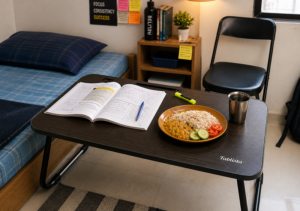

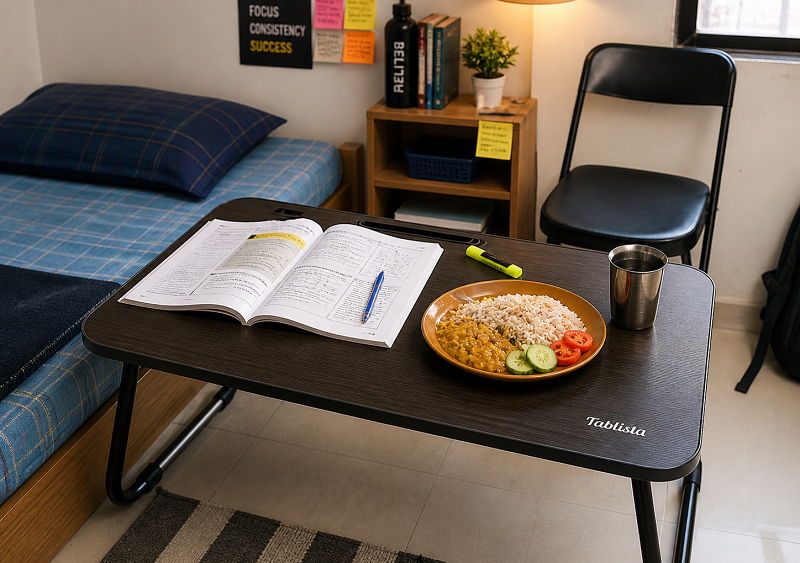
Picture this. You are in a hostel room in Pune or Indore. Your bed doubles as your sofa. Your floor space is roughly the size of a parking spot. Every morning you balance a steel plate on your lap because there is nowhere else to eat, and every evening you sit hunched over a textbook propped against a pillow. You have looked at study tables online, but every option either costs more than your monthly food budget or takes up permanent floor space you simply do not have. This article answers a question students across India are asking right now: is there a single affordable table that works for both studying and eating in a small room? The short answer is yes. By the end of this piece, you will know exactly what to look for, what trade-offs are real versus overblown, and whether the Tablista foldable table from Faburaa fits your specific situation.
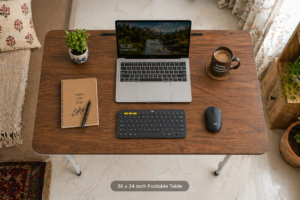
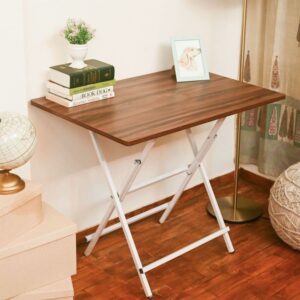
The Tablista dual use foldable table for home is a compact, height-positioned surface that sets up in under thirty seconds and folds flat when not in use. It works on the floor in the cross-legged seating style common in Indian hostel rooms, and it is stable enough to hold a laptop, a notebook, a steel thali, or a plate of rice and dal without wobbling. The tabletop surface is smooth and easy to wipe clean after meals, which matters when the same surface carries textbooks the next morning.
A proper dual use table must do three things well. First, it must hold study materials without vibrating when you type or write. Second, the surface must be food-safe and wipeable without absorbing stains. Third, it must store away completely when not in use so your room does not feel like a furniture showroom.
Most generic folding tables fail at least one of these. Cheap bamboo tops absorb curry stains. Rickety plastic legs make typing feel like writing during an earthquake. And many so-called space savers are still bulky enough that folded storage is impractical in a 100 square foot hostel room.
[INTERNAL LINK OPPORTUNITY] Students looking at multiple compact furniture options often compare this against standalone laptop desks and lap desks — a comparison covered in detail in Faburaa’s guide on Best Desk Size for Work From Home in Indian Homes
At Faburaa, the Tablista table uses an engineered wood top of 15mm with a laminate finish rated for repeated wipe-downs. Engineered wood in this application means layers of wood fibre bonded under pressure, which gives it more resistance to warping from humidity than solid pine or standard plywood — both common in cheaper alternatives sold on general marketplaces.
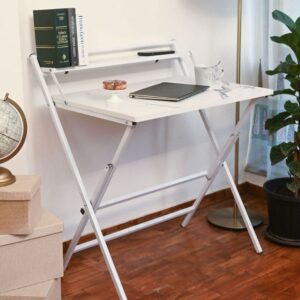
The legs fold inward using a pivot hinge set into the underside of the board. The hinge locks at a fixed angle when the legs are deployed, which prevents the sideways shift you get with loose-pin hinges on cheaper tables. When you fold the table, the legs collapse flat against the board bottom, reducing the whole unit to a flat panel roughly 6 to 8 cm thick.
The surface finish matters for dual use. A raw wood top would absorb spills. A glossy acrylic surface looks good but scratches when you drag a steel plate. The Tablista laminate sits between these two: it resists liquid absorption and survives light scratching from everyday use, though it is not designed for cutting directly on the surface.
Weight capacity is a practical concern for students who use the table for a desktop computer setup or heavy textbook stacks. Faburaa Tablista Foldable table can easily take 50kg of weight.
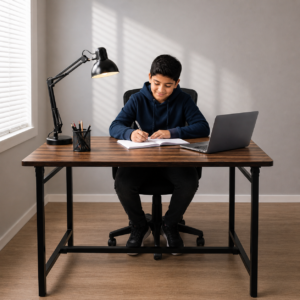
Consider Arjun, a second year engineering student in a private hostel in Nagpur. His room is 10 by 11 feet. He shares it with one other student. The hostel provides a metal single bed and a wall-mounted shelf. No study table. No dining furniture. Arjun eats meals from a tiffin service that delivers to his room. He uses a laptop for assignments and has a full semester of practicals ahead. He needs a surface for eating three times a day and studying four to six hours a day. He has roughly 1800 rupees to spend on furniture.
A permanent table is impossible in his room layout. A lap desk does not hold a laptop plus notebooks side by side. The Tablista table fits his use case because it sets up on the floor, holds the laptop and a notebook simultaneously, wipes clean after meals, and slides under the bed when not needed.
Now consider Priya, a postgraduate student in a working women’s hostel in Ahmedabad. Her room is slightly larger but she works part time and uses her laptop for client calls, meaning stability during video calls is not negotiable. She also has dietary restrictions that mean she eats in her room rather than a common dining area. The Tablista’s locked hinge leg system means the table does not shift position mid-call when she rests her arms on the edge.
These two scenarios represent the majority of buyers for this product. The table does not replace a proper desk for eight-hour daily use. For a student in a shared flat with a spare corner, a wall-mounted desk might serve better long-term. But for a hostel context where space is shared, temporary, and non-customisable, a foldable dual use table is not a compromise — it is the correct solution.
The market for foldable study-cum-dining tables in India runs roughly from 600 rupees to 3500 rupees. The differences across this range are real and worth understanding before buying.
Under 1000 rupees: Usually bamboo or hollow-core MDF with a painted finish. The surface scratches within weeks of regular use. Leg pivots are held by a single bolt, which loosens after repeated folding. Surface area is often too small for a 15-inch laptop plus a notebook.
1000 to 2000 rupees: This is where most hostel-appropriate options live, including the Tablista. Engineered wood tops with laminate replace bamboo or painted surfaces. Leg mechanisms use a locking pivot rather than a loose bolt. Surface area is typically large enough for a laptop and a side notebook, or a thali with room for a glass.
2000 to 3500 rupees: Larger surface area, sometimes with a raised lip to prevent items sliding off, and a heavier frame that improves stability but adds to folded storage size. Useful for someone who uses the table as their only workspace, not specifically for a hostel student.
| Feature | Under ₹1000 | ₹1000–₹2000 (Tablista range) | ₹2000–₹3500 |
|---|---|---|---|
| Surface material | Bamboo or painted MDF | Laminate engineered wood | Laminate or veneer with raised edge |
| Leg mechanism | Single bolt pivot | Locking hinge | Locking hinge with rubber feet |
| Laptop + notebook space | Tight fit, often insufficient | Comfortable for 15-inch laptop | Larger surface, extra room |
| Wipe-clean surface | No (absorbs stains) | Yes | Yes |
| Folded storage thickness | 5–6 cm | 6–8 cm | 8–12 cm |
| Weight capacity (approx) | 8–12 kg | 50–70 kg | 20–25 kg |
| Best for | Occasional light use | Daily study and dining in hostel | Primary workspace in small flat |
For a student on a hostel budget who needs one table to handle both purposes daily, the 1000 to 2000 rupee range delivers the materials and mechanism quality that sub-1000 options cannot.
A full breakdown of what to check before buying any foldable study table is available in Faburaa’s buying guide on space saving study tables in India.
Students increasingly use the table not just for textbooks but for a personal computer setup. A laptop on a floor-level foldable table works well if the screen height is comfortable when seated cross-legged. Most 15 and 16 inch laptops on a table of standard foldable height sit at a reasonable eye level for this posture.
At Faburaa, when designing the Tablista, the height was calibrated for an adult seated cross-legged on a standard hostel mattress or a thin floor cushion. This is a specific design decision, not a generic dimension. A table designed primarily for seated-in-chair use would be uncomfortable at floor level.
For desktop PC use, the table surface needs to hold a keyboard and mouse alongside the monitor or laptop. Depending on the monitor size, this may require using the laptop in closed-lid mode with an external display — a setup that works if your hostel room has the electrical access for it.
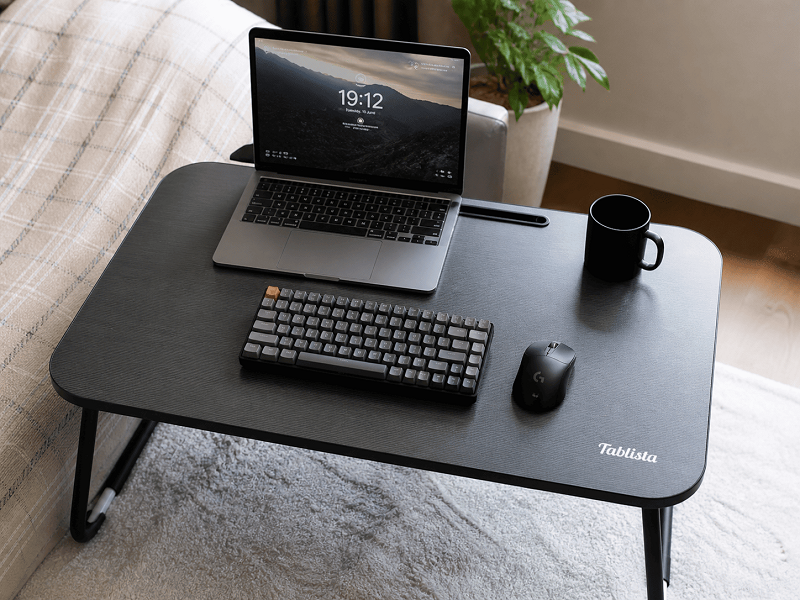
The surface material handles typing without bounce because engineered wood does not flex the way hollow bamboo does. Wrist fatigue from surface vibration — a real complaint with cheap hollow-top tables — is not a concern with this construction.
For students who use their table primarily for extended PC work sessions, Faburaa’s guide on ergonomic home office setups covers screen height and posture in more detail.
The weeks before a new college semester begins are exactly the wrong time to be furniture-shopping without a plan. Hostel rooms fill up. New students need to set up their study spaces before classes begin. Delivery windows from major cities like Mumbai, Pune, and Bengaluru can stretch to five to seven days during peak order periods at the start of the academic year.
Buying the Tablista table two to three weeks before your semester starts gives you the setup time to confirm it works in your specific room layout before your actual study schedule begins. If the table height is not right for your mattress thickness, you find out before you need it for an exam. If the surface is smaller than you expected, you know before your textbooks arrive.
The start of the academic year also represents a clean-slate buying moment. Buying cheap now and replacing it in three months is more expensive than buying the right product once. The price difference between a 700-rupee bamboo table that warps and stains and a 1800-rupee engineered wood table with a proper hinge is roughly 1100 rupees — less than a week of meals for most hostel students.
You now understand the material differences across price tiers, the specific construction of the Tablista foldable table, and why a dual use surface makes practical sense in a hostel room or compact urban flat. The single most common mistake students make is buying the cheapest option available and replacing it mid-semester — paying twice for one problem.
Before you order, confirm three things for your specific situation:
If you need a single affordable surface for daily studying and eating in a space-constrained hostel room, the Tablista dual use foldable table is built for exactly that situation. You can view the full product details and current pricing on the Faburaa Tablista product page.
Yes, provided the surface is laminated or sealed rather than raw wood or painted. Laminate surfaces resist food stains and wipe clean without absorbing moisture, which matters when the same surface holds textbooks the next morning. The Tablista table uses a laminate engineered wood top for exactly this reason. Avoid bamboo or painted-wood surfaces for dual use — they stain within weeks of regular meal use.
The table is designed to hold a laptop, keyboard, and notebook simultaneously. The engineered wood top does not flex under typing pressure, which prevents the surface vibration that makes cheaper hollow-top tables uncomfortable for extended use. For a standard 15 to 16 inch laptop setup, the surface area and weight tolerance are both sufficient for daily college use.
For an adult seated cross-legged on a standard single hostel mattress or a 5 cm floor cushion, a table height of 27 to 32 cm from the floor places the laptop screen at a comfortable angle. Tables designed for chair height (70 to 75 cm) are uncomfortable at floor level and create wrist strain during extended study sessions.
The folding mechanism on the Tablista requires no tools and no assembly each time. Unfolding takes under thirty seconds — flip the table over, push the legs out until the hinge locks, and set it upright. Folding is the reverse. This matters for daily hostel use where the table may need to be stored multiple times a day to free floor space.
The folding mechanism on the Tablista requires no tools and no assembly each time. Unfolding takes under thirty seconds — flip the table over, push the legs out until the hinge locks, and set it upright. Folding is the reverse. This matters for daily hostel use where the table may need to be stored multiple times a day to free floor space.
The Tablista surface accommodates a laptop used as a display with an external keyboard and mouse placed in front. Whether this works comfortably depends on whether your laptop can function in closed-lid mode with an external display and whether your hostel room has accessible power points at floor level. For a standard laptop-only setup, the surface area is sufficient without any extensions.
A laptop table is designed for a single use: holding a laptop, typically with ventilation gaps cut into the surface. The Tablista is a flat, sealed surface designed for multiple uses including meals, writing, and computer work. Laptop tables often have poor surfaces for writing by hand and cannot be used for food without the risk of spills entering the ventilation gaps. The Tablista’s solid laminate surface handles all three uses without modification.
A damp cloth with mild soap is sufficient for daily cleaning. The laminate surface does not require any special cleaning product. Avoid abrasive scrubbers, which can scratch the finish over time, and avoid leaving standing water on the surface for extended periods. For curry or oil stains, a small amount of dish soap on a soft cloth removes residue without damaging the surface.
The Tablista arrives partially assembled. The folding leg mechanism is pre-fitted to the board. No tools are needed for initial setup or for daily use.